The First Founders Decks Are Coming Soon -- Don't Miss Your Spot!
Beyond A–Z: Why the Alphabet is Only Half of the Reading Code
INSIDE THE FORGE
4 min read
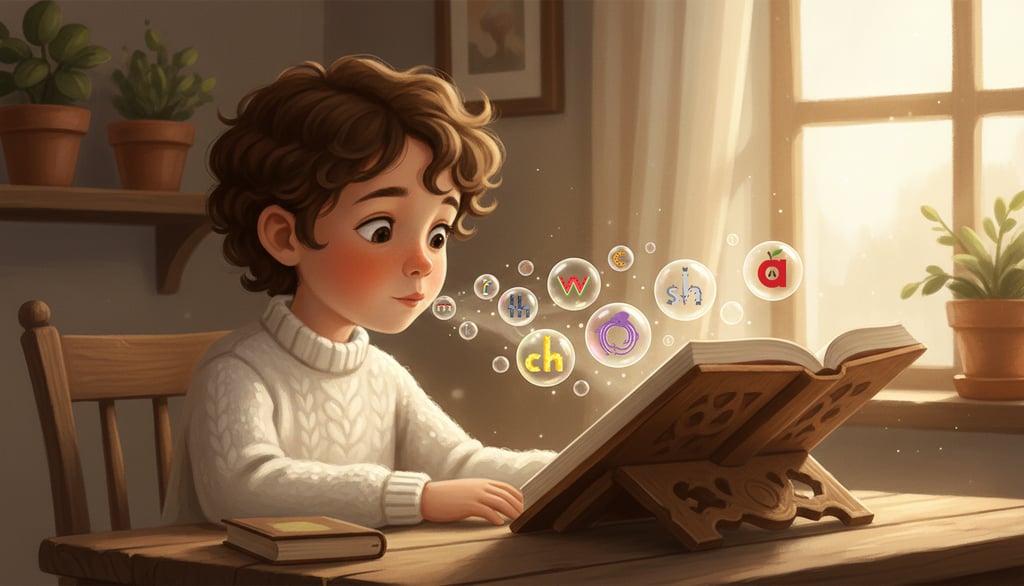

Most of us learned to read starting with A–Z. So naturally, that's where we start with our kids.
And honestly? That's a perfectly good place to begin. The alphabet gives us the building blocks of written language. But here's the thing, reading is actually a bit bigger than the alphabet alone.
Once you understand why, the whole system starts to make a lot more sense.
Your child already knows more than you think
Before your child ever holds a book, they've already been building a foundation for reading, through talking. Think about it. By the time most kids start kindergarten, they are already language powerhouses. According to developmental research, most 5-year-olds have already mastered:
Rhyme Recognition¹: They know stair and chair belong together.
Syllable Clapping¹: They can hear the "beats" in air-plane or boat.
Advanced Speech²: They are already using thousands of words and complex sounds like "sh" and "ch" to tell you exactly why they need that snack right now.
Reading is really just the next step: connecting the sounds they already use to the symbols they see on a page.
Here's the catch with 26 letters
English has 26 letters. But spoken English has more sounds than that.
So written English has to get creative. Some sounds are written with one letter. Some use two letters together. Some change depending on where they show up in a word.
Most children are already using sounds like sh and ch in everyday speech by the time they reach school. Others, like th, are still developing, but they’re already part of the sound system children are learning to hear and produce.
So reading doesn’t start from scratch.
It builds on sounds children already know and shows them how those sounds are written.
What happens when we show kids the full picture early?
There are two ways to approach this.
One way: start with single letters, then slowly introduce the rest later.
Another way: show kids both single letters and common two-letter patterns right from the beginning.
Research suggests that second approach, sometimes called mixed-grain instruction, actually helps kids build a more flexible understanding of reading ³. Instead of thinking "each letter makes one sound" (which, in English, is... not always true), they start to grasp that sounds can be written different ways.
That's a small shift that makes a big difference later on.
Why does this matter in real books?
Because real books don't wait.
Some of the most common words kids encounter in early reading (the, that, she, fish ) all include patterns like th and sh. These aren't rare or advanced. They show up constantly, right from the very first pages. In fact, some of the most frequently used words in the English language rely on two letters working together. So reading was never really just about individual letters, it couldn't be.
When kids already recognize those patterns, reading feels more predictable. And when reading feels predictable, they learn faster because they're not constantly being surprised by something that seems to break the rules.
A little trick from speech-language therapy
Here's something therapists have known for a long time: visuals help kids remember sounds.
When a child is working on a tricky sound, therapists often pair it with a picture, something concrete and easy to remember. The picture gives the child something to hold onto while the sound itself is quick and easy to forget.
Now imagine if that picture wasn't sitting next to the letter, but was actually built into the shape of the letter itself.
That's the idea behind embedded picture mnemonics. The image becomes part of the letter. So instead of memorizing a symbol, the child sees something familiar. The picture helps them remember the sound. The letter shape becomes part of that memory. Two for the price of one.
Bringing speech and reading together
These two things, learning to say sounds, and learning to read them, are usually treated as totally separate. But they don't have to be.
When the visuals used to support speech are connected directly to print, kids get both at the same time. They're reinforcing the sounds they already know while building their reading foundation.
What this looks like in practice
This is the thinking behind the Phonic Forge Gold Foundation Deck.
It includes all 26 letters, each illustrated and connected to its most common sound. But it doesn't stop there. It also includes the consonant sounds in everyday English that don't have a single letter of their own, like sh, ch, th, and ng.
These aren't exotic sounds. Kids hear and use them every day. The deck just makes sure they can see them too, so nothing gets left out of the picture. These two things, learning to say sounds, and learning to read them, are usually treated as totally separate. But they don't have to be.
When the visuals used to support speech are connected directly to print, kids get both at the same time. They're reinforcing the sounds they already know while building their reading foundation.
They already know the sounds.
Now let them to see them.
Most of us were taught that reading starts with the alphabet. And it does, but it doesn't end there. English is a bigger system than 26 letters, and kids who understand that early don't have to unlearn anything later. They just keep building. That's the real gift of starting with the full picture.
References
Paulson, L. H. (2004). The development of phonological awareness skills in preschool children: From syllables to phonemes (Doctoral dissertation, University of Montana). University of Montana ScholarWorks. https://scholarworks.umt.edu/etd/9522
Crowe, K., & McLeod, S. (2020). Children’s English consonant acquisition in the United States: A review. American Journal of Speech-Language Pathology, 29(4), 2155–2169. https://doi.org/10.1044/2020_AJSLP-19-00168
Vadasy, P. F., & Sanders, E. A. (2020). Introducing grapheme-phoneme correspondences (GPCs): Exploring rate and complexity in phonics instruction for kindergarteners with limited literacy skills. Reading and Writing. Advance online publication. https://doi.org/10.1007/s11145-020-10064-y
Questions? We're happy to help.
info@graphonicmnemonics.com
© Graphonic Mnemonics LLC | Privacy Policy | Terms & Conditions