The First Founders Decks Are Coming Soon -- Don't Miss Your Spot!
Evidence Based: The Mathematical Logic and Multisensory Science of Phonic Forge
INSIDE THE FORGE
4 min read
Nothing in Phonic Forge is random.
From the highly engaging illustrations children love, to the carefully selected sound patterns, to the repetition built into each mini-game, each detail follows evidence-based design logic. The result is a learning system that feels playful and intuitive in a child’s hands while quietly building the neural pathways needed for reading success.
Here is the science behind those choices.
Focusing on the "Power Patterns" First
Imagine you had a giant bucket of 1,000 building blocks, but only 100 of them were needed to build a cool spaceship. You’d want to find those 100 pieces first, right?
Reading works the same way. Some letter–sound patterns show up in almost every book, while others are much less common. By letter–sound patterns, we mean both single letters that make a sound (like m, t, s) and letter chunks that work together to make one sound (like sh, th, ch, wh, or vowel patterns like ee, oa, ay).
In literacy science, these are called grapheme–phoneme correspondences (GPCs)—the connection between what children see in print and the sound they say out loud.
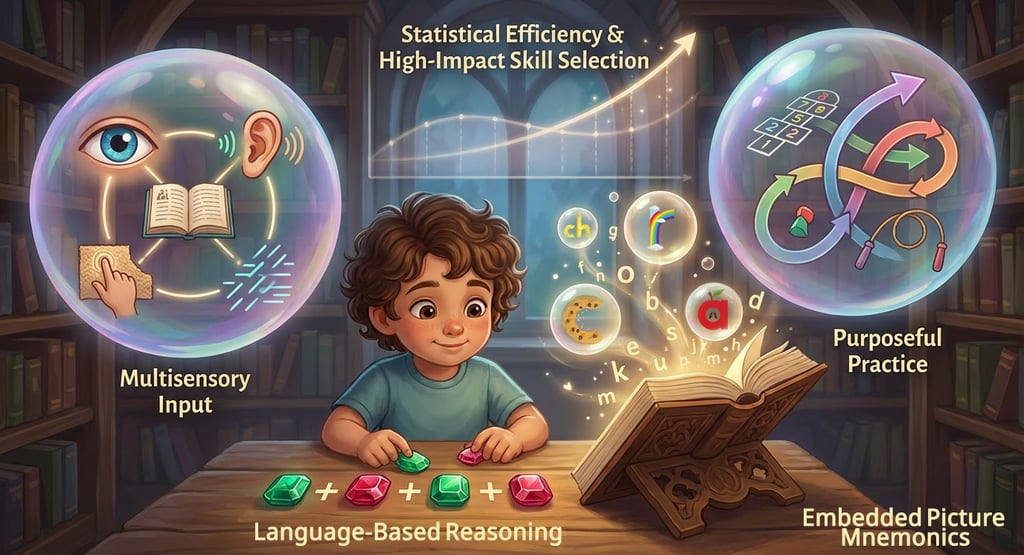
Phonic Forge uses mathematical logic to prioritize the "Power Patterns." These are the highest-impact sounds, from single letters like m and s to chunks like sh and ch, that children will see and use most often.
By learning these first, children can start reading real words much faster. They get to feel the "win" of reading early on, which keeps them excited to learn more.
Sounds You Can See and Say
To a child, letters can often look like just a bunch of squiggles on a page. Many letters look strikingly similar, just like the lowercase b and d. That's why reversals are so common when children first begin reading.
In Phonic Forge, we use Embedded Picture Mnemonics. That is a big name for a simple idea: we build a picture right into the shape of the letter to show its sound. When a child looks at a letter, the picture helps them "see" the sound. It’s like having a little map that shows them exactly what to say.
By turning a letter into a picture, we also give the brain a story to hold onto. These stories anchor the letter's direction so it feels intuitive rather than abstract. For example:
“Dog at the door” helps a child remember that the d begins with the round part before the tall line.
“First the bat, then the ball” helps them see that the b starts with the tall line before the round shape.
Instead of trying to memorize a flat symbol, the child can replay a tiny story in their mind. This makes the sound stay in their memory much better than a plain black letter ever could.
Using All the Senses
Learning becomes much stronger when multiple systems in the brain work together. Phonic Forge is intentionally multisensory, which means children are learning through more than just looking at letters. As they play, they are:
Seeing vibrant illustrations and letter forms.
Hearing letter sounds on their own and inside words.
Saying the sounds out loud and noticing how their mouth moves.
Touching and moving the cards as they sort, match, tap, and build patterns.
When children use their eyes, ears, voice, and hands all at once, they are building stronger connections between what they see, hear, feel, and say. The result is a deeper learning pathway that helps sounds and letter patterns stick more naturally over time. It’s like building a triple-strength bridge in the brain.
Repetition That Builds "The Reading Reflex"
Practice is important, but the kind of practice matters just as much. To become a strong reader, a child needs to look at a letter and say the sound instantly, without having to stop and think. Scientists call this automaticity, but you can think of it as a "Reading Reflex."
To make that "Reading Reflex" second nature, 6 of our 7 mini-games are specifically built to train your child's brain to recall sounds quickly. Instead of doing the same worksheet, flashcards, ask-answer-repeat drill over and over, children build their skills through different styles of gameplay:
Familiar Classics: Games like matching and Go Fish help children feel comfortable and successful right away. These are a little slower and are perfect for starting out if your child is new to rule-based gameplay.
High-Energy Fun: In Swipe or Strike, the pace picks up! It’s a fast-flipping duel where players race to name the sound on each card. But watch out! When an action card appears, players have to react fast by smacking the pile or swiping the plushie!
Teaching Categorization: In games like Consonant , Consonant, Vowel!, children race to say a sound and then perform the high-level skill of deciding if it’s a consonant or a vowel. This skill is essential for building the word patterns that help children read and spell later on.
Because every game has a different pace and different rules, the learning stays fresh. Children get the hundreds of "reps" they need to make sound-retrieval automatic, but they are too busy having fun to notice.
One Deck, Many Skills
The most effective learning tools do "double duty." Because Phonic Forge uses the same cards across seven different game formats, children aren’t just practicing letter sounds—they are strengthening a whole toolkit of thinking and communication skills every time the rules change. As they play, children are also building:
Social Connection: Through shared play, children learn the importance of patience, taking turns, and following rules together.
Reasoning and Logic: Whether they are explaining why a move worked or how sounds combine to build a word, they are learning to think critically about language.
Flexible Thinking: Shifting between different game rules using the same cards helps children develop executive function—the ability to stay organized and adapt to new challenges.
Focus and Self-Control: Fast-paced rounds require quick decisions and "response control," helping children learn to stay calm and focused even when the game gets exciting.
Layered Literacy: The cards are designed to grow with your child. They might start by naming pictures, move to letter sounds, and eventually use those same cards to blend and decode real words.
This is what makes the deck so efficient. These cards are designed to level up alongside your child, supporting them as they are ready to reach for higher levels of language, reasoning, and reading.
Evidence Matters for the Real World
Every part of Phonic Forge was designed with a clear purpose and backed by evidence. Created by a speech-language pathologist for the real world, these games are built for environments where time is short and every moment of learning needs to count.
By using mathematical logic to focus on high-impact patterns and multisensory learning to help those sounds "stick," we’ve created a tool that does the heavy lifting for you. Instead of drills that target a single skill at a time, we connect language, logic, and literacy all through purposeful play.
Questions? We're happy to help.
info@graphonicmnemonics.com
© Graphonic Mnemonics LLC | Privacy Policy | Terms & Conditions