Our First Founders Decks Are Going Fast -- Claim Yours Before They're Gone!
Why It Works: The Science of Embedded Picture Mnemonics
INSIDE THE FORGE
10 min read
Start With the Question You’re Already Asking
As educators and parents, we’ve all been there: watching a child stare at a letter as if it’s a meaningless squiggle. For years, the "logical" approach was to avoid pictures, fearing they were a distraction¹.
And the experts were partly right. Research shows that when a picture sits next to a letter, the brain often prioritizes the familiar illustration over the unfamiliar symbol. It's as if the picture steals the spotlight. The child quickly recognizes the picture, but the abstract letter shape receives far less attention. This is known as the overshadowing effect, and it helps explain why many traditional keyword cards can unintentionally slow down letter-sound learning.
The Logic Trap in Traditional Reading Materials
Many of the tools used in classrooms, tutoring centers, and therapy rooms today were built on what seems logical, rather than what helps the brain learn efficiently. At first glance, the traditional "beginner-friendly" checklist sounds perfectly reasonable:
Teach one simple letter at a time.
Save complex digraphs (like sh, ch, th) for much later.
Place a helpful picture next to the symbol for reference.
Keep early materials visually basic.
But this is exactly where the logic trap happens. Research shows that these common methods can actually make letter-sound learning slower and more difficult.
The Problem with "Side-by-Side" Pictures
Lets take a closer look at traditional keyword cards. With traditional flashcards, a picture sits next to the letter rather than being built directly inside it. For a child, using these cards often looks like quick success. They eagerly point to the apple, smile when they recognize the cat, and proudly say the words they already know.
But here is the problem: Their eyes almost always land on the familiar picture before the brain has fully processed the letter shape itself.
Because the brain feels rewarded for successfully recognizing a known object, it often "skips" the hard work of studying the abstract symbol. This is the overshadowing effect in action. A parent might notice this through a few common red flags:
The child seems to "know it" during practice but has no memory of the sound the next day.
They frequently mix up similar-looking letters once the pictures are removed.
They keep glancing at the corner of the card for a "hint" instead of looking at the print.
What looks like learning in the moment can sometimes be picture recognition instead of true letter-sound learning. That's why side-by-side keyword cards can accidentally create the illusion of progress while slowing the child’s ability to build a strong memory for the letter itself.
The Digraph Delay
Imagine teaching a child to play the piano using only their index fingers for two years. It seems "simpler," but it builds a habit that makes actual music impossible. When the other fingers are introduced, the child is frustrated, not just because their limited method fails on every real song, but because that first habit is so difficult to unlearn.
The same bottleneck happens when we delay digraphs.
When we teach only single letters for too long, children build a misleading rule: one letter equals one sound. This feels manageable at first, but English doesn't work that way. High-utility sounds like sh, th, ch, and ee are multi-letter chunks (often referred to as digraphs).
By holding digraphs back until "after the alphabet," we lead children into a letter-by-letter decoding strategy that inevitably breaks down. A child can know every single letter but still freeze on basic words like ship, path, or feet. To them, reading begins to feel random and inconsistent.
The solution is mixed-grain instruction²³. When digraphs are introduced alongside single letters from day one, children build a flexible, accurate strategy. Instead of later having to "undo" a false rule, they naturally learn to spot powerful sound chunks first.
The common complaint that "English is inconsistent" is rarely about the language. It’s about a limited instructional sequence. By teaching the "full keyboard" of sounds from the start, we give children the tools to actually play the music of reading.
The Hidden Cost of Small Design Choices
When a child’s attention is pulled away by the overshadowing effect, or when high-utility digraphs are delayed, the result is slower learning and more frequent reteaching. This small decision quietly stretches the path to mastery, making reading feel harder than it needs to be.
While some children can learn from traditional flashcards and posters with pictures next to letters, there is a significant group of learners that hit a total bottleneck. The mental processing load of familiar pictures next to the unfamiliar letters is too great, and this stalls learning. These children don't need more repetition. What they need is less cognitive friction.
The goal isn't just to find a method that "works" for some. The better question is: Which design gives the most children the fastest path to decoding, the strongest grip on memory, and the greatest sense of confidence?
When materials are built for efficient memory and flexible decoding, every child wins.
For some, it improves speed.
For others, it changes the entire trajectory of learning.
The Solution: "Memory Glue" for the Brain
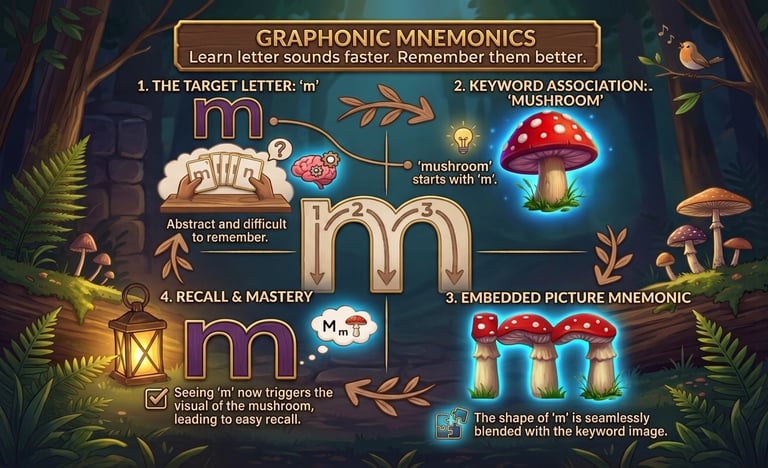
The subtle design choice that changes everything is the Embedded Picture Mnemonic. Instead of placing an image beside the letter, we build a meaningful image directly into the structure of the letter itself. Instead of competing for attention, the image and the letter merge into one.
Graphonic Mnemonics™, are a distinctive collection of 65 uniquely illustrated letter forms. Each one functioning as an embedded picture mnemonic designed to make letter-sounds easier to learn and remember. This set of modern images was created by a speech-language pathologist and carefully refined through years of real-world use with children. When the picture of a mushroom is drawn into the letter m , the child cannot look at the picture without also processing the letter's shape. The picture becomes the "memory glue" that anchors the abstract shape to a known word, which in turn triggers the sound.
How and Why They Work in the Brain
Research in cognitive science explains the effectiveness the picture embedded mnemonics:
1. Dual Coding Theory (The "Additive Effect")⁴⁵
Our brains store information in two separate but interconnected systems: verbal (sounds) and visual (images). By embedding a letter into a picture, the brain effectively doubles the probability of retrieval. If the child forgets the abstract sound, they access the visual image to cue the correct verbal response.
2. The "Best Friend" Analogy
To a child, a bare letter is a total stranger. But a "snake" or a "horse" is an old best friend. Embedded mnemonics are like having that best friend dress up in a letter-shaped costume. The child recognizes their friend "hiding" inside and already knows exactly what sound that friend makes.
3. Neural Connectivity
Multisensory instruction, by engaging visual and auditory pathways, activates multiple brain regions simultaneously. This leads to increased connectivity within the brain's "reading network," making the storage and retrieval of letter-sound associations more efficient.
When “I Forgot” Becomes a Clue Trail
One of the most powerful things about embedded picture mnemonics is that forgetting is no longer a dead end.
In traditional letter-sound drills, if a child can’t recall the sound, the learning moment simply stops. All you know is that the connection didn't stick. But an embedded picture mnemonic provides a problem-solving trail. A series of signposts that reveal exactly where the memory pathway broke down.
The First Signpost: The Hidden Picture
The most critical clue is this: Can the child remember the picture hiding inside the letter?
The strategy works by anchoring an unfamiliar symbol to a word the child already knows. If the picture name isn't accessible, the mnemonic has nowhere to "park" in their memory. This is why keyword choice is the heartbeat of the system. To be effective, the word must:
Contain the target sound.
Map clearly to the letter’s physical shape.
Resonate as a word children can easily recognize and name.
Connect to vocabulary they already possess or can quickly "fast-map."
Vocabulary as a Diagnostic Tool
When a child can’t name the picture, the "clue" becomes a diagnostic insight. Sometimes, it’s a simple lack of exposure. A typically developing language learner might only need a few repetitions to bridge the gap.
However, if the child struggles to name the picture even after repeated exposure, it points to broader language-learning challenges. That insight is important. It tells you the child may need additional language scaffolding to help build and stabilize the speech-to-print pathway.
Walking the Memory Path
Once the child can name the picture, you can walk the trail together. Instead of guessing, the child engages in a sequence of speech-to-print reasoning:
Teacher: "What picture is hiding inside this letter?"
Child: "Mushroom."
Teacher: "Great. What is the first sound in mushroom?"
Child: "/m/."
Teacher: "Exactly. So, what sound does this letter make?"
In this moment, the child isn't just reciting; they are utilizing vocabulary retrieval, visual recall, and initial sound isolation to locate exactly where that sound is stored in their brain.
From Trail Guide to Independent Explorer
With plain letters alone, a child saying “I forgot” often brings the learning moment to a halt. The pathway ends there, leaving you only with the knowledge that the sound wasn’t immediately available.
But with an embedded picture mnemonic, “I forgot” becomes the start of a useful clue trail. It transforms a moment of potential failure into a map that reveals exactly what the child needs next.
At first, the adult acts as the guide, stopping at every signpost and asking the essential questions:
What was the picture?
What was the first sound?
What does that mean this letter says?
When you walk that path enough times, something powerful happens: the child begins to navigate it alone. They stop waiting to be told the answer and start directing their own thinking. By asking themselves those same questions, the picture guides them back to the sound, transforming a memory aid into a self-guided strategy for true independence.
Proven Statistics & Efficacy
In learning, efficiency is about more than just saving time; it’s about reducing frustration. When a child learns faster, they feel more capable. This is why Embedded Picture Mnemonics are such a game-changer. They provide a high-speed retrieval pathway that traditional rote memorization simply can't match. The results aren’t just incremental. They’re transformative.
The Power of the "Memory Glue" Sound
In one study, a student demonstrated a staggering 5,800% gain in letter-sound fluency following mnemonic intervention⁴. To be clear, a figure that dramatic requires context: the student began at a near-zero baseline, averaging just 0.30 correctly named letters per minute. After intervention, that performance soared to 17.7 letters per minute.
While that percentage reflects a low starting point, the success was far from an isolated incident. Other children in the same study showed equally incredible improvements, with gains of 4,038%, 589%, and 570%⁴.
The "Double-Speed" Sound Foundation
The speed of acquisition is only half the story; the other half is cognitive "stickiness." Research highlights a dual benefit to this approach:
Acquisition: In just seven weeks, children taught with embedded picture mnemonics learned nearly double the number of letter sounds compared to those using plain letters.
Spontaneous Blending: Remarkably, these same children saw almost double the growth in their blending skills, despite never being explicitly taught how to blend sounds into words.
Because the embedded picture mnemonics made the sounds so "sticky" in their minds, the children’s brains were freed up to start combining those sounds into words naturally and spontaneously⁵.
10+ Letters in 2 Weeks Time
Most traditional programs hope for a handful of letters a month. The data shows we can do better. Research proves children can learn between 12-20 different letter-sound connections in just two weeks without becoming overwhelmed⁶⁷. This accelerated rate of learning is evidenced by transitional first graders with special needs who, when presented with 20 consonant letters, reached a 90% mastery criterion in an average of only 12 sessions, roughly two weeks of instruction. Similarly, studies with younger learners have shown that students can acquire 12 letters over just six sessions across two weeks, with those in picture embedded mnemonic conditions achieving significantly higher letter-sound knowledge compared to those receiving traditional instruction without integrated picture support.
What is Phonic Forge™?
If you are looking for something simple enough for families to grab and play, yet layered with the kind of research-backed specificity speech-language pathologists, reading specialists, teachers, and interventionists know to look for, that is exactly what Phonic Forge was built to be™.
Phonic Forge™ is a fast, fun, and flexible phonics card game that turns all of the science we just explored into something children can actually use through play. Powered by 65 uniquely illustrated Graphonic Mnemonics™, the deck turns learning science into seven engaging mini-games that make practice playful and easy to repeat.
So if this article gave you a new way to think about early reading, please share it with the parents, teachers, therapists, and specialists in your life.
Many families still have no idea that small design choices can make letter sounds easier to learn, quicker to remember, and far more joyful to practice.
The more people who understand how embedded picture mnemonics work, the more children can experience the early wins that build confidence, decoding, and reading success.
More families deserve to know there’s another way.
References
Shanahan, T. (2014, October 11). A question I hate: Should we use pictures (embedded mnemonics) when teaching phonics? Shanahan on Literacy. https://www.shanahanonliteracy.com/blog/a-question-i-hate-should-we-use-pictures-embedded-mnemonics-when-teaching-phonics
Vadasy, P. F., & Sanders, E. A. (2021). Introducing grapheme-phoneme correspondences (GPCs): Exploring rate and complexity in phonics instruction for kindergarteners with limited literacy skills. Reading and Writing: An Interdisciplinary Journal, 34(1), 109–138. https://doi.org/10.1007/s11145-020-10064-y
Cheng, Y.-L. (2015). Effects of the Revelational Phonics approach on Chinese L1 EFL beginners' knowledge of the English alphabetic principle: Further evidence from 'whole word', 'single letter-sound', and 'digraph' reading. Chang Gung Journal of Humanities and Social Sciences, 8(2), 347–379.
Grünke, M., Gürcay, I., Bracht, J., Jochims, A., Schulden, M., Barwasser, A., & Duchaine, E. (2024). Enhancing grapheme-phoneme correspondence learning: A single-case study using picture mnemonics. International Electronic Journal of Elementary Education, 16(3), 417–425. https://doi.org/10.26822/iejee.2024.342
Roberts, T. A., & Sadler, C. D. (2018). ABC Letterland: A specialized mnemonic program for learning letter–sound correspondences. Journal of Research in Reading, 42(2), 238–256.
de Graaff, S., Verhoeven, L., Bosman, A. M. T., & Hasselman, F. (2007). Integrated pictorial mnemonics and stimulus fading: Teaching kindergartners letter sounds. British Journal of Educational Psychology, 77(3), 519–539. https://doi.org/10.1348/000709906X160011
Fulk, B. M., Lohman, D., & Belfiore, P. J. (1997). Effects of integrated picture mnemonics on the letter recognition and letter-sound acquisition of transitional first-grade students with special needs. Learning Disability Quarterly, 20(1), 33–42. https://doi.org/10.2307/1511091
Questions? We're happy to help.
info@graphonicmnemonics.com
© Graphonic Mnemonics LLC | Privacy Policy | Terms & Conditions